Scale Agent Operations
AI agents that run a small company’s daily work.
We are building, with Claude Code, an operating system of AI agents that takes routine work off small teams, checks every result against the real thing, and stops for a person before anything risky.
Small companies do not lack ideas. They lack hands for the daily work that keeps a shop or a site alive. We run our own company on this system first, and we are turning what works into something other small teams can use.
About the company
Scale Co., Ltd. (株式会社Scale) was founded on August 1, 2022. It runs a moss-terrarium e-commerce shop, and does the fitment-data and SEO work for a tire and wheel fitment site.
- Company
- Scale Co., Ltd. (株式会社Scale)
- Founded
- August 1, 2022
- Domain
- moss-scale.com
- Runs on it
- A moss-terrarium e-commerce shop; fitment-data and SEO work for a tire and wheel fitment site
- Stage
- In use internally. Not yet a public product.
How we use Claude today
Claude Code is used every day on a Claude Max plan. As the orchestrator it plans the work, dispatches it to worker agents, and accepts or sends back what they return.
Claude also does production work. The routine worker agents (Hermes) run on OpenAI and xAI models, but design skeletons, high-volume copy drafting and model-comparison grading are done with Claude (Opus, Sonnet and Haiku).
We pick the Claude model per task by testing. In a 5-task internal comparison (one run per setting), Sonnet and Opus at high effort each scored 20/20, and Haiku scored 15/20 by default and 17–18/20 with effort set. Routine checks go to Haiku; judgment-heavy work goes to Opus or Sonnet.
What it runs today
A moss-terrarium e-commerce shop
Product information, listing text and content production across several marketplaces, drafted by agents and checked against the shop’s own rules before a person approves. shop.moss-scale.com
Operated by Scale Co., Ltd. (see the shop’s legal notice)
Fitment data and SEO for a tire and wheel fitment site
Research, SEO planning and fitment data work. Safety-critical values are verified against source data, never invented, and anything unverified is marked as such.
The live system
Two views rendered from the shelf and review records our own system writes during daily operation, with names, customers, prices and internal addresses removed.
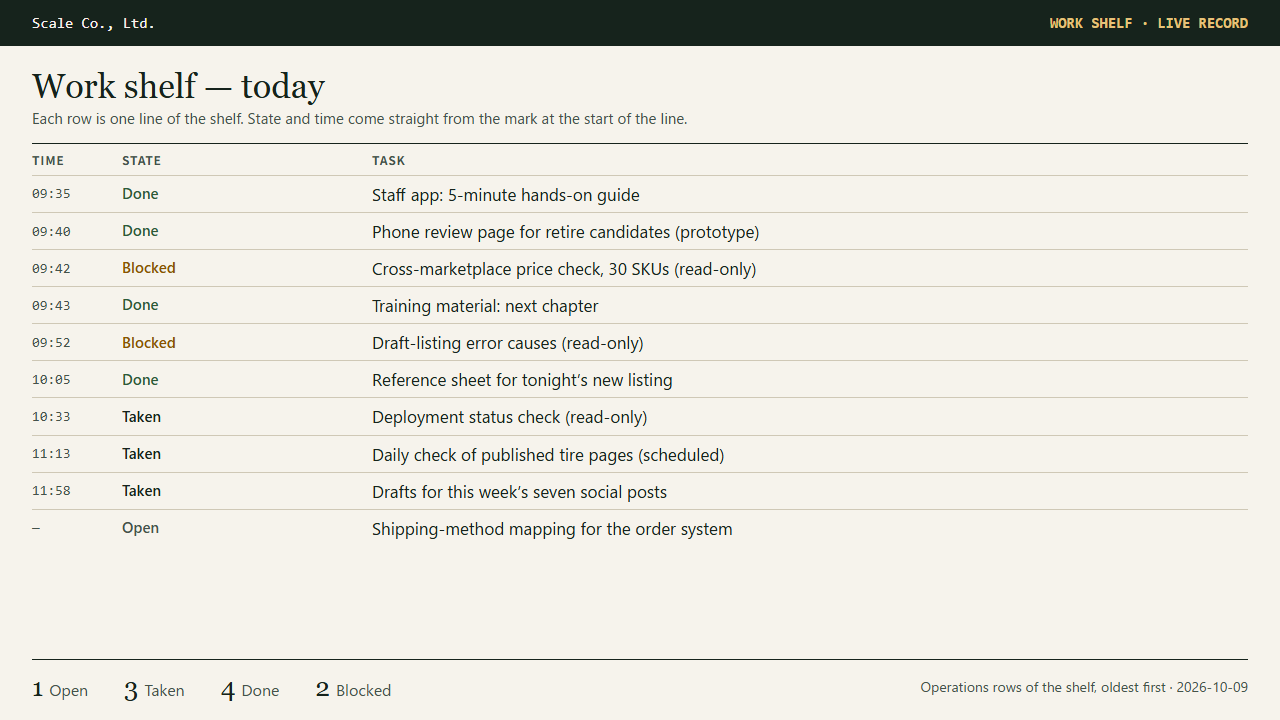
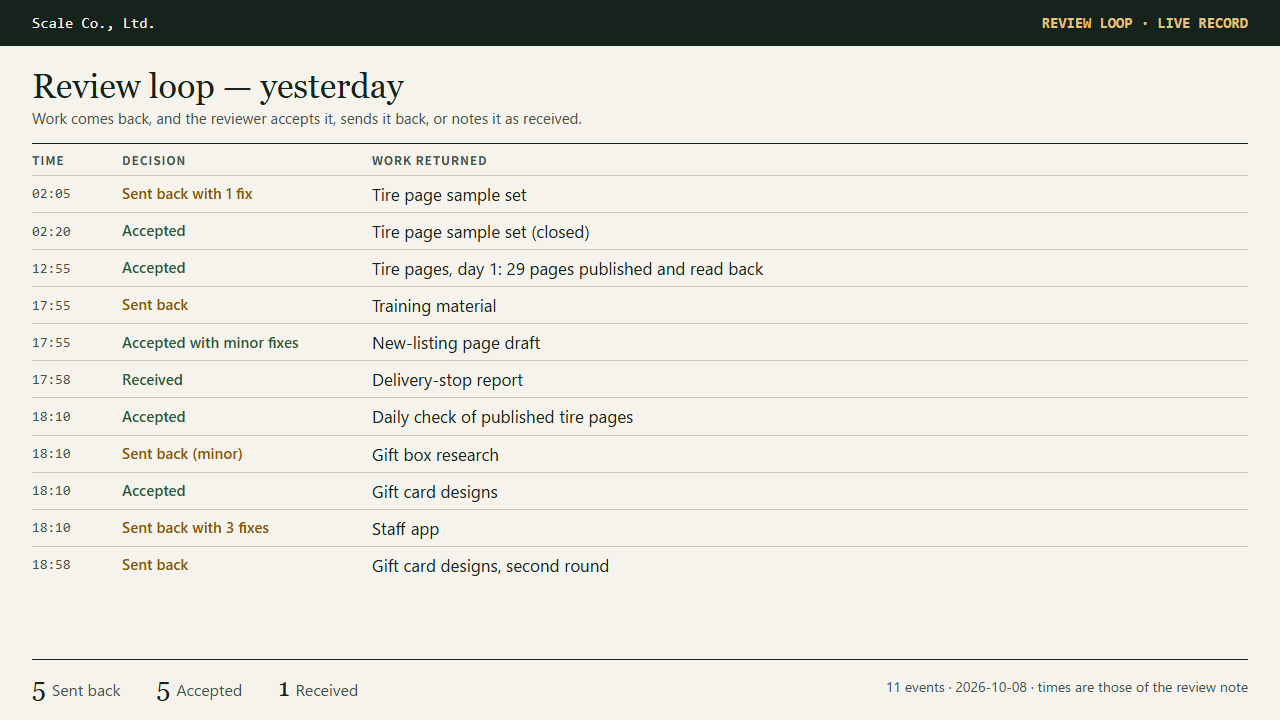
An illustration of the flow: plan, dispatch, check, and ask a person.
This is a scripted illustration with invented sample data, not evidence of results. A real request moves the same way: an operator asks in plain language, the orchestrator splits the work, worker agents do it, the orchestrator checks what comes back, and the risky step waits for a person.
Try a request
Try the words publish, delete or moss.
All names, counts and files in this demo are invented sample data. The real system works the same way, against real files, with the same approval stops.
How it works
Claude Code is the orchestrator: it writes the plan, dispatches each scoped task, opens and checks every returned file against its source, and holds risky steps for a person.
Routine worker agents (Hermes) carry out the scoped tasks on other vendors’ models chosen per task (OpenAI and xAI); design skeletons, high-volume copy drafting and model-comparison grading are done with Claude.
-
Take the request
An operator writes what they want. The orchestrator turns it into a plan with a clear scope per task and says up front which steps are risky.
-
Dispatch to worker agents
Each task goes to a worker agent (Hermes) with a narrow brief, and, where it matters, a second worker agent is assigned to check the first.
-
Verify against the real artifact
A report saying “done” is not evidence. The orchestrator opens the actual file, page or record, compares it with the source, and sends mismatches back.
-
Stop at the approval gate
Billing, publishing, deleting, and anything touching credentials wait for a person. The operator sees what will change before it does.
-
Hand off and keep the record
Work moves between machines through a shared drive. Every request, plan, check and approval is written down, so the next session starts from facts, not memory.
People stay in charge of anything that cannot be undone
The system is built to be fast on reversible work and slow on irreversible work. These actions always wait for a person.
| Action | Rule |
|---|---|
| Spending money | Nothing that bills a card or an account runs without a person’s explicit yes. |
| Publishing | Pages, listings and posts stay drafts until a person approves what goes public. |
| Sending outside | Messages to customers and partners are drafted by agents and sent by people. |
| Deleting | Agents do not delete. They prepare a list; a person acts on it. |
| Credentials | Keys and passwords live outside shared storage and are never passed through agents. |
Where we are. This system runs our own operations. It is not yet a public product, we have no outside customers, and we are not publishing outcome numbers until we can measure them honestly.
What Claude credits would accelerate
Every plan, dispatch and verification runs through Claude Code.
- Hardening the verification step so more kinds of results can be checked against real artifacts automatically.
- Turning our approval gates and activity record into a reusable, documented tool instead of a set of house rules.
- Writing and testing runbooks so a new small team could adopt the same operating method.
- Building a public demo wired to sample data, so the interactive demo above can run against a safe sandbox.
Over the next six months, credits would fund Claude API usage: the sandboxed public demo, which calls Claude directly, and running orchestration and grading through the API as the work grows beyond one subscription.